
Before Buying an Air Quality Monitor, Read This
Something feels off about the air in your house, but you can’t quite put your finger on why. Maybe it’s the headaches that show up after a few hours indoors, maybe it’s wildfire smoke drifting in from somewhere else, or maybe you just read an article about indoor pollution and now you can’t stop wondering what you’re actually breathing. So you start looking at air quality monitors, hoping one will finally give you a straight answer.
Here’s the catch nobody tells you upfront: a monitor doesn’t clean anything. It just tells you what’s going on. That’s incredibly useful information, but only if you buy the right kind of monitor for the question you’re actually trying to answer — and that’s where a lot of people end up confused, staring at a number on a screen with no idea whether it’s good, bad, or meaningless.
It’s a bit like buying a thermometer and expecting it to fix the temperature on its own. The real value is in the information it gives you, and what you choose to do with that information — not in the gadget sitting on your shelf.
Why This Problem Happens
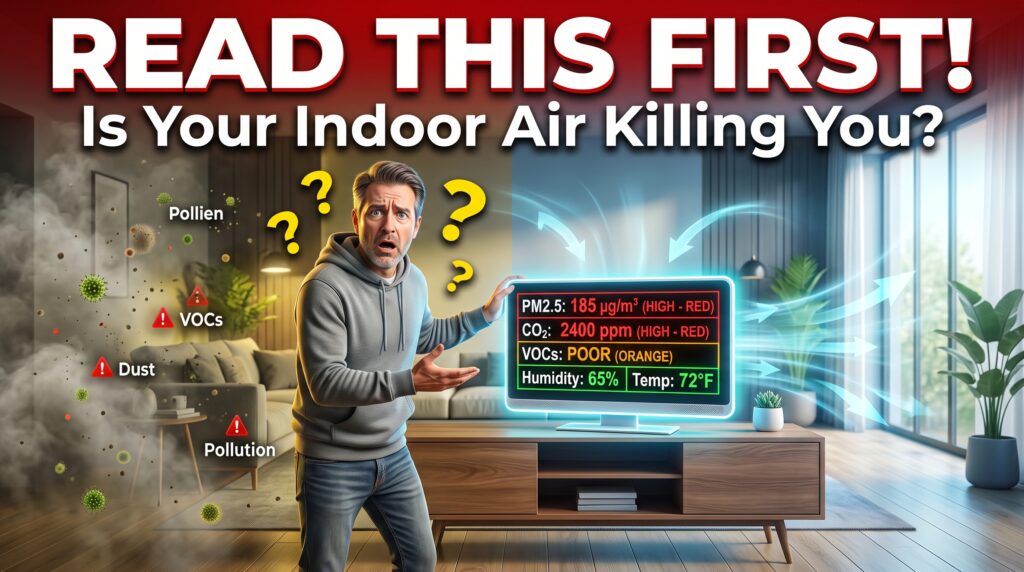
“Air quality” isn’t one single thing you can measure with a single sensor. It’s a catch-all term that covers several completely different pollutants — fine particulate matter (PM2.5) from smoke, dust, and cooking; carbon dioxide buildup from poor ventilation; volatile organic compounds (VOCs) off-gassing from paint, furniture, or cleaning products; plus humidity and temperature, which affect comfort more than health directly.
A cheap monitor that just displays a vague “air quality index” might only be measuring one of these things, even though the branding makes it sound like it’s covering everything. And not all sensors are created equal — a proper CO2 sensor uses NDIR (non-dispersive infrared) technology, while a cheap stand-in might estimate CO2 based on VOC levels, which can give you misleading numbers without you ever knowing it. This is really the root of most buyer disappointment: people assume “air quality monitor” means one universal device, when really it’s a category with very different tools built for very different jobs.
Common Mistakes People Make
People run into trouble in a few predictable ways here. A lot of buyers grab a monitor without first deciding what they’re actually worried about — wildfire smoke calls for a PM2.5 sensor, a stuffy bedroom points to CO2, and a chemical smell from new furniture is a VOC question, but one budget device rarely nails all three well. Then there’s the assumption that any “air quality” label covers everything, when in reality plenty of cheap units only track one or two metrics and dress it up as a full picture.
Accuracy gets overlooked too. Some lower-end sensors give readings that swing around in ways that don’t match reality, which is fine if you’re just curious but a problem if you’re making real decisions based on the number. People also forget that placement matters — set the thing right next to a kitchen, a window, or an air vent, and you’ll get skewed readings that don’t reflect the room as a whole. And it’s easy to miss the fine print on subscriptions: some monitors need an app and a paid cloud plan just to unlock historical data or extra features, which isn’t always obvious at checkout. Finally, sensors themselves have a lifespan — CO2 and VOC sensors in particular can drift out of calibration over a year or two, and a monitor that’s never recalibrated will quietly start lying to you.
Solutions: What to Figure Out Before You Buy
Start by getting honest about what you’re actually trying to solve. If smoke or dust is the concern, you want a real laser-based PM2.5 sensor, not a vague index. If it’s stuffiness, headaches, or a room that never feels fresh, CO2 is probably your number — and you’ll want a monitor that uses proper NDIR sensing rather than an estimate. If you just renovated or bought new furniture and you’re worried about fumes, look for one with a dedicated VOC sensor.
From there, a little research goes a long way — independent reviews and side-by-side accuracy tests tend to tell you a lot more than the marketing copy on the box. Where you place the monitor matters just as much as which one you buy: aim for somewhere central, roughly at breathing height, away from direct drafts, vents, or the kitchen, so the reading actually reflects the room you’re living in. Check ahead of time whether the features you care about — like trend graphs or smartphone alerts — require an ongoing subscription, since that’s an easy thing to miss until after you’ve already bought it. And once you have readings coming in, actually use them: open a window when CO2 climbs, run a purifier when PM2.5 spikes, instead of just watching numbers update without doing anything about them.
Affiliate Product Recommendations
- Aranet4 Home — A standout for CO2 monitoring specifically, with a genuine NDIR sensor, long battery life, and no subscription required.
- IQAir AirVisual Pro — Tracks PM2.5, CO2, humidity, and temperature in one device, good if you want broad coverage rather than a single metric.
- Temtop M10 Air Quality Monitor — A budget-friendly multi-sensor option for people who want a general sense of PM2.5 and VOC levels without a big investment.
- PurpleAir PA-II-SD — Popular for real-time PM2.5 tracking, especially among people keeping an eye on wildfire smoke or outdoor air feeding into the home.
- Awair Element — Combines CO2, VOCs, humidity, and temperature with a clean app interface, useful if you want one device covering several concerns at once.
Product Comparison
Monitor | Tracks | Best For | Subscription Needed |
Aranet4 Home | CO2 | Ventilation, stuffy rooms | No |
IQAir AirVisual Pro | PM2.5, CO2, humidity, temp | All-around tracking | No |
PurpleAir PA-II-SD | PM2.5 | Smoke and outdoor air | No (community data is free) |
Final Recommendation
Don’t buy an air quality monitor the way you’d buy a thermometer, expecting one simple number to tell the whole story. Figure out what’s actually bothering you first — smoke, stuffiness, fumes, or a mix — and let that decide which sensor type you actually need. A dedicated, accurate device aimed at your real concern will tell you far more than a cheap all-in-one gadget with a vague “air quality” score on the front.
If you’re not sure where to start, a CO2 monitor like the Aranet4 is one of the most useful entry points — stuffy, headache-inducing rooms are an extremely common (and fixable) problem, and seeing the number climb in real time is often the moment people finally understand why a room feels the way it does. From there, you can always add a PM2.5 or VOC sensor once you know exactly what else you’re dealing with.
There’s no need to solve every air quality concern with a single purchase. Most people end up building toward a fuller picture over time, one sensor at a time, as they figure out what’s actually affecting their space.