
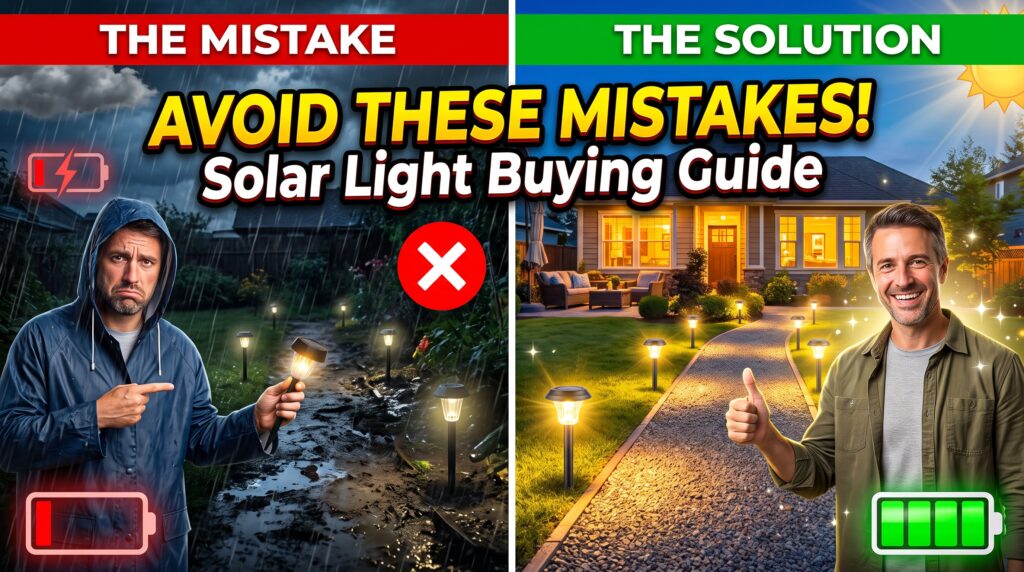
Before Buying Solar Lights, Know These Common Mistakes
Solar lights appear to be the ideal outdoor light. Easy to install, no complex wiring, no cost to your electric bill, and sometimes sold as “green. Not surprisingly, many homeowners purchase a set online, install them around their garden, a pathway or porch in one afternoon, and enjoy years of trouble-free operation.
Unfortunately, not everything goes as expected in the experience.
Some people find that after a few days or weeks their solar lights are not as bright as they would like them to be. Some lights fail to function, don’t keep burning during the rainy season or don’t function throughout the entire night. An initially good and inexpensive improvement can turn out to be a wasted investment.
Fortunately, solar lights aren’t necessarily the cause of the issue. Often, the problem lies with a few common issues; like using low quality products, lighting in shaded regions, or lack of understanding about solar charging. If you and your family have proper expectations, and a little planning, solar lights can be a reliable, attractive and economical way to light up your outdoor space. It is important to know these common mistakes before you buy, so that you won’t have to experience disappointment or disappointment if you make the wrong choice.
Why This Problem Happens
Solar lights are not like conventional outdoor lights, and require several parts to function together in harmony. A solar cell, a rechargeable battery, an LED light bulb and a light sensor are included in each unit. The panel absorbs sunlight during the day and converts it into energy to be stored in the battery for the night in the form of light from the LED.
Each of them is responsible for a certain portion of the performance and if one is not of a good quality, damaged or poorly matched, the whole system may become substandard, resulting in low light output, reduced operating times, and eventual failure.
There are a few common causes for poor performance of the solar lights:
- The panel is not receiving enough direct sunlight (shade, dust or the wrong angle)
- The battery isn’t of good quality or can’t hold up for long.
- The light is for ambience, rather than brightness, but it’s being used for security
- Cheaper components tend to last longer when protected from weather exposure (rain, snow, excessive temperatures).
None of this is to say that solar lighting should be disregarded. It simply means the kind of solar light and where you place it have a lot more significance than you think.
Common Mistakes People Make
These are the reasons why most people complain the solar lights don’t work:
- Purchasing the lowest cost, without knowing the lumens. Brightness is also one thing that’s often associated with price and if you have a big space in mind, you may just need to have a more expensive light.
- Positioning them in an area that is shaded or partially covered. Just a few hours of shade a day can significantly reduce charging capacity.
- Failing to recognize the type of battery. Lights use NiMH batteries tend to lose charge more quickly than lights with lithium batteries.
- Not testing for weatherproof rating. A light without an adequate IP rating will not be able to withstand rainfall or snow.
- Relying on decorative lights as security lights. String lights and lanterns are not designed to be bright enough or sensitive enough to motion detection to be used for security lighting.
- Not fully charging prior to first use. Many solar lights require 1-2 days of direct sunlight to operate at their peak efficiency.
Don’t worry about seasonal changes in sunlight. A site which is very sunny during the summer can only charge the panel effectively during the winter.
Solutions: What to Do Before You Buy
When shopping for solar lights, follow these steps:
- Examine your sun exposure. Take a day to observe the hours of actual sun exposure that your installation location will receive.
- First identify the purpose. Do you need a light for a walkway, to decorate your patio or for safety? The kind of lights you need depends on the purpose.
- Match the brightness to the job. Pathway lights should not be as bright as spotlights or security lights; be sure to inspect lumens, not just price.
- Prioritize lithium-ion batteries. They are faster charging, have a longer life, and are more resistant to cold than older NiMH batteries.
- If the lights are likely to be exposed to rain or snow, be sure to find a model that has a good IP rating, which is at least IP65.
- Don’t worry about judging performance until they have fully charged. Before deciding “too dim,” give new lights a few full days of sunlight.
Once you’ve tacked these basics, selecting the genuine products becomes much easier.
Affiliate Product Recommendations
These five categories of solar lighting solutions are available and are the most likely to be used, depending on the most common needs:
- Solar Pathway Lights (e.g., GIGALUMI Solar Pathway Lights) — Ideal for lining a garden path or driveway; easy stake-in installation.
- Solar Spotlights (e.g., URPOWER Solar Spotlights) Perfect for tree lighting, flag lighting and architectural features.
- Solar Motion Sensor Security Lights (e.g., Litom Solar Motion Sensor Lights) — ideal for entryways, garages and places where security is more important than ambiance.
- Solar String Lights (e.g., Otdair Solar String Lights) — Ideal for outdoor entertaining, patios, or pergolas that require mood lighting.
- Solar Lanterns (e.g., Aootek Solar Lanterns) — A flexible, portable table top or step or hanging lamp.
Product Comparison
Type | Best For | Pros | Cons |
Solar Pathway Lights | Walkways, driveways | Easy install, affordable, low maintenance | Limited brightness, mainly decorative |
Solar Spotlights | Highlighting features | Brighter, adjustable angle | Needs more direct sun to perform well |
Solar Motion Sensor Lights | Security, entryways | Strong brightness on trigger, energy-efficient | Higher price point, battery drains faster with frequent triggers |
Final Recommendation
If you are new to solar lighting, you don’t have to replace your outdoor lighting system all at once.
- You can take a step-by-step approach to determine what works best for your room and to save on costs.
- Begin with 2-3 solar pathway lights in your sunniest side of your yard and test the illumination and battery capacity for 1 week.
- For extra security or visibility, mount an extra motion-sensor solar light near your front door, driveway or entry area.
- When you’re happy with the outcome, take it outdoors to another spot.
If you’re a beginner, just a couple of solar pathway lights and one motion-sensor security light is the sweet spot of affordability, convenience and practical performance.