
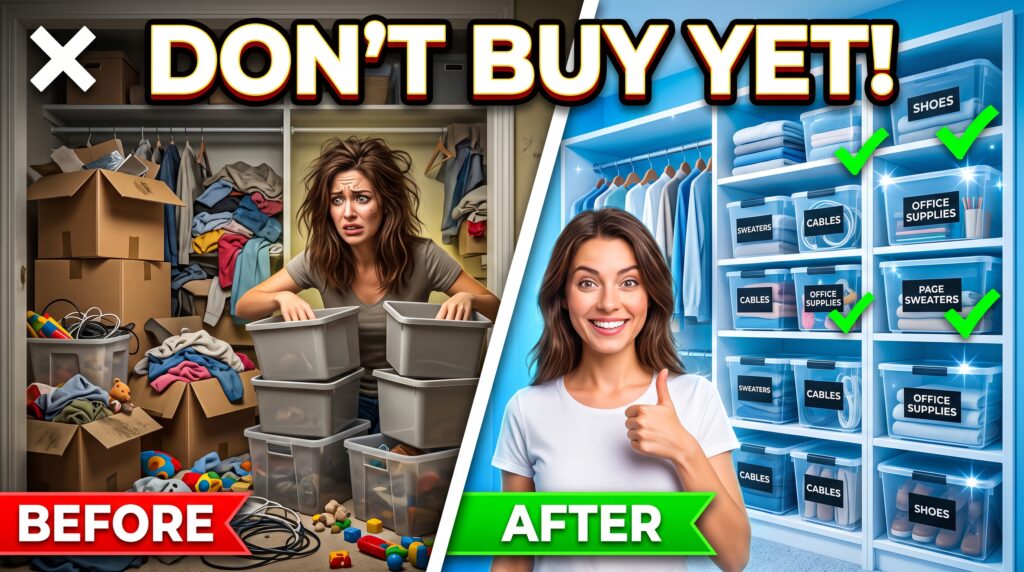
Before Buying Storage Bins, Read This
The closet is overflowing, the garage shelves look like a game of Tetris nobody’s winning, and you finally decide enough is enough — time to get organized. You grab a cart full of storage bins, fill them up over a weekend, and feel genuinely accomplished. Then a few months later, you’re digging through four identical-looking boxes trying to find a single charger cable, two of the bins won’t stack properly anymore, and one lid has popped off so many times you’ve given up putting it back on.
The bins didn’t fail you exactly — they just weren’t chosen with much of a plan, which is an easy trap to fall into when you’re standing in a store aisle trying to solve a mess you’re tired of looking at.
Why This Problem Happens
Storage bins get bought reactively more often than not — you’re frustrated with the clutter, you want a fix today, and you grab whatever’s available without measuring the actual space it needs to fit into. That’s how you end up with bins that are an inch too tall for the shelf, or too wide to fit two across, wasting space that a properly sized bin would have used efficiently.
Material matters more than people expect, too. A cardboard box might be fine in a dry closet but turns soft and moldy fast in a humid basement. Clear plastic that looks great in a climate-controlled room can become brittle and yellowed after a summer in a hot garage. Fabric bins breathe well for clothing and linens, but they’re a poor choice anywhere moisture is a concern. None of this is obvious when you’re comparing bins side by side in a store — it only shows up months later, in the specific environment you’ve actually put them in.
There’s also a sizing trap that’s easy to miss: the same bin that’s perfect for a garage shelf might be completely wrong for a closet, simply because the available depth and height differ by a few inches. People often buy one style for the whole house, assuming a single size fits every space, when really each room tends to have its own quirks worth measuring separately.
And maybe the biggest issue isn’t about the bins at all: a storage bin solves a containment problem, not a decluttering problem. If you skip the step of actually deciding what you’re keeping and what you’re getting rid of, the bins just give your clutter a nicer outer shell. The mess is still there — it’s just zipped up and harder to see, which can almost make it worse, since it’s now easy to forget about entirely.
Common Mistakes People Make
The most common one is buying bins before measuring the space — shelf height and depth, closet dimensions, under-bed clearance — and ending up with something that doesn’t actually fit the way you imagined. Mixing random sizes and shapes is another frequent issue; without a consistent system, bins don’t stack cleanly, and vertical space goes to waste.
Choosing opaque bins for things you need to find quickly turns simple tasks into a guessing game, especially once several identical-looking boxes pile up. Using cardboard in damp or pest-prone areas like basements and garages invites mold, softening, and the occasional unwelcome visitor. Skipping secure latching lids on bins that get moved or stacked often leads to lids popping off at the worst possible moment, usually while carrying one down from a high shelf. A lot of people also skip labeling entirely, assuming they’ll just remember what’s in each bin — which works for about a month before everything blurs together. And probably the most common mistake of all: buying a stack of bins as a way to avoid the harder work of actually sorting and purging, which just relocates the clutter instead of resolving it.
Solutions: What to Do Before You Buy
Measure first. Check the shelf height and depth, closet dimensions, or under-bed clearance before you buy a single bin — this one step prevents most of the sizing headaches people run into later. Where possible, pick a uniform size and shape across your storage system, since matching bins stack cleanly and make far better use of vertical space than a mismatched collection ever will.
Choose clear or semi-clear bins anywhere quick visual identification matters, like closets or pantries, and save opaque bins for places where contents don’t need to be seen at a glance, like under the bed or a high shelf. Match the material to the environment: sturdy, weatherproof plastic for garages and basements, breathable fabric for clothing and linens in dry closets, and avoid cardboard anywhere humidity or pests are even a mild concern. If bins will be stacked, moved, or stored somewhere they might get knocked, prioritize ones with secure latching lids rather than simple snap-on tops.
Set up a basic labeling system — even masking tape and a marker works, though a label maker makes it look more permanent and tidy. And before you buy anything, sort through what you actually have first. Decide what’s being kept, donated, or tossed, and only then figure out how many bins you genuinely need. Buying bins for stuff you haven’t decided to keep yet is how closets end up just as full as before, just with nicer-looking boxes.
Affiliate Product Recommendations
- IRIS USA Stackable Storage Bins — Clear, uniformly sized, with latching lids, a strong all-purpose pick for closets and shelving.
- Really Useful Boxes — Durable and weatherproof, well suited for garages, attics, and basements.
- Sterilite Latch Boxes — A budget-friendly option with secure lids, good for general household storage.
- SimpleHouseware Underbed Storage Bins — Specifically sized for under-bed clearance, ideal for seasonal clothing or linens.
- Brother P-touch Label Maker — Makes setting up a consistent labeling system quick and far more durable than tape and marker.
Product Comparison
Bin Type | Weatherproof | Latching Lid | Best For |
IRIS USA Stackable Bins | Yes | Yes | Closets, general storage |
Really Useful Boxes | Yes | Yes | Garages, attics, basements |
Sterilite Latch Boxes | Moderate | Yes | Budget-friendly general use |
Final Recommendation
Before adding anything to your cart, measure the actual space you’re working with and take a real pass at sorting through what you own. Storage bins work best as the final step in getting organized, not the first one — buying them too early just means packing clutter into nicer containers instead of dealing with it.
Once you’ve sorted and measured, lean toward a consistent, stackable system in a material suited to where it’s going, and don’t skip the labeling step. It’s a small bit of extra effort upfront that saves you from digging through five identical bins trying to find one extension cord six months from now.