
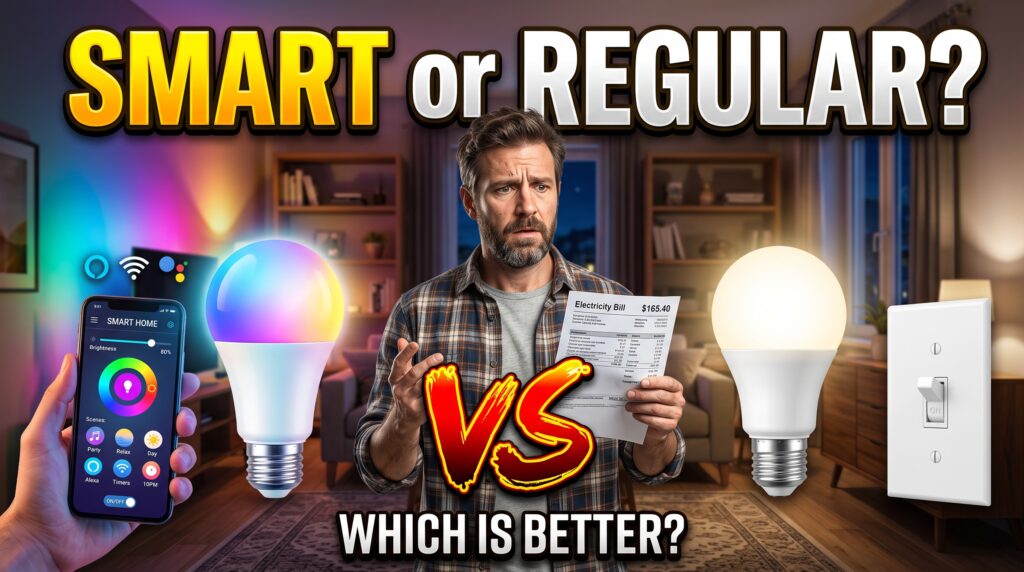
Are Smart Lights Worth the Extra Cost?
How much do Smart Lights cost and is there any point in paying for them? Read This First
Struggling to keep lights on and constantly change their settings at home? Frequently adjusting the lights at home, and tired of wasting electricity?
Have you ever left your house and asked, “Did you turn off the lights?”
Perhaps you’ve looked at your electricity bill, and felt that same sense of frustration when the bill turned out to be higher than what you anticipated.
You’re not alone.
It is a fact that there are a lot of people who have light problems at home that they are battling with on a daily basis. Empty rooms have lights turned on. The family members fail to switch them off. Some rooms are too sunny and others are not sunny enough. Then, once you’ve got a nice, comfortable spot to sit, you need to stand up only to adjust the light.
These minor annoyances can seem so trivial at the time, but it can add up over years.
Electricity costs, wasted electricity, needless bulb replacement and no control over home lighting can add up to be quite an issue.
This is one of the reasons why smart lights are so popular these days.
People will frequently talk about using a phone to control lights, voice assistants, or even set up automatic times. Though it seems convenient, many homeowners question if it’s worthwhile to install smart lights as an added expense.
Why This Problem Happens
People don’t do things on purpose that cause lighting problems. These occur due to the lack of flexibility and control in the traditional lighting systems.
We Rely on Memory.
The traditional lights are manually operated. They have to be switched on and off.
Unfortunately, this is not easy because of the busy schedules. Rushes to work, leaves for school or runs out for errands and forgets about the lights.
Each room has its own specific requirements.
There are different types of lighting for a bright kitchen than there are for a bedroom.
However, many houses are equipped with the same type of bulb throughout the entire house.
This can result in unpleasantly dark, ill-fitting, or uncomfortable areas.
Energy Waste Happens Without Notice
If you leave lights on in all the rooms that are not being used, then electricity will be being used while they are not in use.
But most homeowners don’t realize they are losing energy until they get their monthly utility bill.
Modern lifestyles require more convenience.
Today’s homeowners demand convenience.
We can lock doors remotely, watch security cameras on our phones and even operate the home thermostat by voice.
The lighting that we have traditionally used is quite out of fashion when it comes to the rest of our connected devices.
Common Mistakes People Make
Nonetheless, before considering smarter lights, it is important to realize some common mistakes that many people make that can be the cause of lighting problems.
Turning lights on at all times of the day. Switching lights on continuously.
- Incorrect brightness is set. Viewing on wrong brightness.
- The Option of Cheap Bulbs Only
- Ignoring Lighting Schedules
- Overlooking Automation Opportunities
There are numerous issues with lights that can be fixed using technology, and some still manage to use light manually.
This can result in a lack of efficiency and undue stress.
Practical Solutions before Buying Smart Lights
Prior to purchasing smart lights, consider these practical solutions: Before shopping for smart lights, try these practical solutions:
Step 1: Evaluate Your Lighting Habits
Observe your home use of lights for a week!
Ask yourself:
- Which of the lights will stay on the longest?
- What rooms and facilities are not frequently utilized?
- What kind of lights do you tend to forget to use?
These details can be used to determine areas that need to be improved.
Step 2: Switch to Energy-Efficient LED Bulbs
If you do use them, the first thing to change is to use incandescent or halogen bulbs.
LED bulbs:
* Use less electricity
* Last longer
* Produce less heat
* Lower replacement costs
Step 3: Use Natural Light
Open curtains and blinds while daylight hours.
There is a reduction in the need for man-made light, and a happier home environment, as it can come from natural sunlight.
Step 4: Create Lighting Zones
Each room is used to perform a function.
Make use of varying light levels in various rooms – don’t have all lights of the same intensity in the home.
Step 5: Set Daily Lighting Routines
But even if you don’t use smart devices, implementing a family practice of turning off the lights can make for a lot of waste savings.
Step 6: Consider automation as appropriate.
You don’t need to have all your home’s lights as smart.
Highlight locations where there are a lot of vehicles that would gain the most from automation.
Affiliate Product Recommendations
These products can be measured for improved convenience, reduced energy waste and a shrewder home.
- Smart LED Bulbs
It is the most prevalent lighting solution where smartness can be achieved.
Features often include:
* Smartphone control
* Voice commands
* Scheduling
* Dimming
* Color adjustment
Smart bulbs are perfect for bedrooms, living rooms and home offices.
- Smart Plugs
Don’t want to change out all your bulbs?
Smart plugs can control and automate lamps and existing lighting fixtures.
Benefits include:
* Scheduled operation
* Remote control
* Energy monitoring
* Affordable automation
These are typically the simplest smart home product to get started in.
- Motion Sensor Light Switches
Automatically switches lights on/off with occupancy.
Perfect for:
* Hallways
* Bathrooms
* Garages
* Laundry rooms
This will make the number of lights that remain powered down to be reduced.
- Smart Light Strips
These are popular for use as mood lights.
Great locations include:
* Bedrooms
* Entertainment rooms
* Gaming setups
* Home theaters
Both functional and stylish.
Product Comparison
Let’s have a look at three popular light solutions.
Standard LED Bulbs
Pros
* Inexpensive
* Energy well-organized
* Easy installation
* Extended lifetime
Cons
* No mechanization
* No isolated control
* Partial customization
Smart LED Bulbs
Pros
* Full remote control
* Voice associate compatibility
* Forecast features
* Adaptable brightness
* Convention colors
Cons
* Higher acquisition price
* Needs Wi-Fi
Motion Sensor Lighting
Pros
*Saves unnecessary electricity use.
* Simple operation
*Easy to use by busy homes!
Cons
* Limited customization
*May require installation
Choose best practice energy saving.
Are Smart Lights Actually Worth the Extra Cost?
Everyone wants to know the answer to this question! As far as priorities are concerned, it’s your choice.
If you’re looking to save money on your electric bill, the standard LED light bulbs could be the most cost effective option.
They are cost effective, effective and durable. But when convenience is a top priority, smart lights may be able to provide you a benefit that can’t be matched by traditional lighting.
Imagine:
- Using your cell phone to turn off all of the lights in your home.
- Lighting for earlier than arrival at home.
- Dimming the lights in the house when inside the couch.
- The voice control of multiple rooms.
- Daylight saving automatic light control.
Smart lights cannot necessarily dramatically reduce your electric bill, compared to standard LED lights, but they can certainly make light much more convenient and manageable.
Who Should Buy Smart Lights?
Smart lighting is most suitable for:
* Busy professionals
* Frequent travelers
* Smart-home enthusiasts
* Families with children
* Home office workers
Final Recommendation
If you are a first-time smart home user, don’t rush to change all the light bulbs in your home.
The simplest way for most people to get started is to switch out the poor quality incandescent light bulbs in the house for quality LED bulbs. This will instantly help increase the energy efficiency and cut down on electric bills.
After that, install one or two smart bulbs in the rooms where you use them most such as the bedroom or living room. With this, one can enjoy the advantages of smart lighting without having to invest heavily.
If you want to add things to your setup over time, you can do this. So, do you need to pay for smart lights? If your primary goal is to save money, then regular LED light bulbs may be your initial option.
For those with a need for convenience, automation, comfort, and modernity, smart lights can certainly be worth their while. The best first step for novices is to start with LED lights, experiment with a couple of the smart lights, and gradually build up the smart lights.