
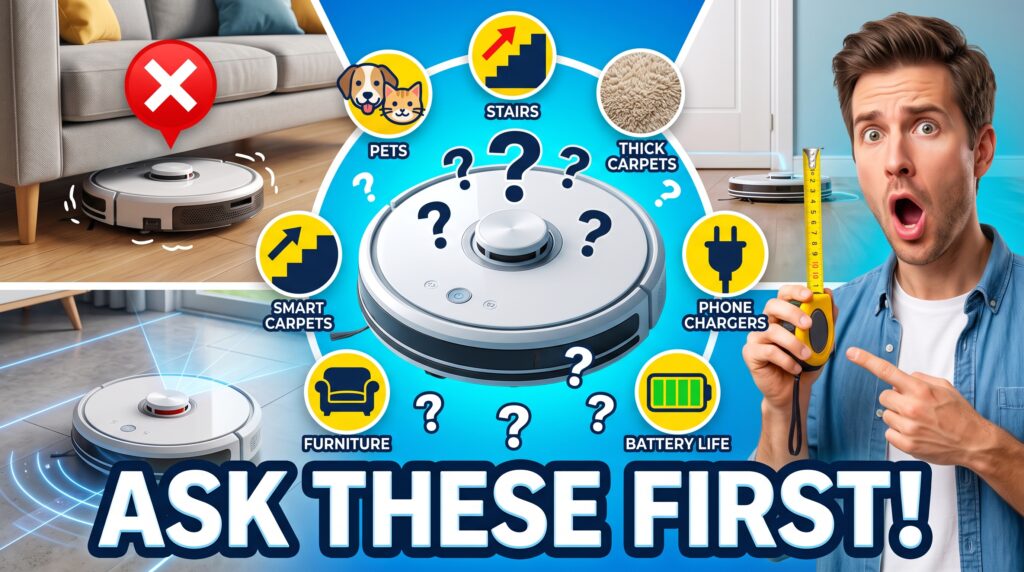
Before Buying a Robot Vacuum, Ask Yourself These Questions
The idea is irresistible: a little disc gliding around the house on its own schedule, quietly handling the floors while you do literally anything else. So you buy one, set it running, and come home to find it wedged under the couch, tangled in a phone charger cord, or stuck on the edge of the bathroom rug, blinking an error light at no one. It’s not broken — it just wasn’t really built for your home’s specific layout, and nobody warned you that this mattered before you bought it.
Robot vacuums genuinely work, and for a lot of households they’re a real time-saver. But “robot vacuum” covers an enormous range of capability, and the gap between a budget model and a higher-end one is a lot bigger than the price difference alone suggests.
Why This Problem Happens
Cheaper robot vacuums often rely on basic bump-and-turn navigation — they move in a fairly random pattern, bouncing off obstacles and changing direction, rather than actually mapping the room. More advanced models use lidar or camera-based mapping to clean in efficient rows, remember your floor plan, and let you set no-go zones through an app. That difference alone explains a lot of the disappointment people feel: a budget bot in a cluttered, multi-room home can leave obvious gaps, while the same model in a simple, open studio apartment might perform just fine.
Suction power, brush design, and battery life vary just as much. A unit with weaker suction will struggle on thick carpet or high-pile rugs, even if it handles hardwood floors well. Brushes designed without pet hair in mind tend to tangle badly and need constant manual cleaning. And runtime that sounds generous on paper can still mean multiple charging cycles to finish a larger home in one go. None of this is obvious from a glance at the price tag — it really comes down to matching the robot’s actual specs to your home’s specific layout and cleaning demands.
App-based features add another layer of variation. Mapped models typically let you set no-go zones, schedule specific rooms, and review a cleaning history, while basic models often have little more than an on/off button and a charge indicator. For some households, that level of control barely matters; for others — especially homes with a baby’s play area or a room that needs to stay robot-free — it’s the difference between a tool that fits seamlessly into daily life and one that needs constant supervision.
Common Mistakes People Make
A lot of buyers grab the cheapest option without checking what kind of navigation it actually uses, then end up frustrated by missed spots or an oddly inefficient cleaning pattern. Cord and clutter management gets overlooked too — phone chargers, loose cables, and small objects on the floor are a common reason robots get stuck or have their brush clogged mid-run, and a quick pre-clean habit isn’t something everyone accounts for ahead of time.
People with thick carpets or high-pile area rugs sometimes expect a robot vacuum to deep clean the way a full-size upright does, when suction power varies enormously between models and price points. Pet owners run into a specific version of this problem — a brush that isn’t designed to resist tangling can turn into a hair-wrapped mess after just one or two runs. Furniture clearance is another quiet issue: some robots are taller than expected and simply can’t fit under certain couches or cabinets, something that’s easy to miss until the unit gets stuck trying. And multi-level homes complicate things further, since most robot vacuums can’t handle stairs — meaning you either carry it between floors yourself or budget for more than one unit. Finally, skipping the self-emptying base question can quietly bring back the manual labor people were trying to avoid in the first place, since basic models need their dustbin emptied after nearly every cleaning cycle.
Solutions: Questions Worth Answering Before You Buy
Start with your floors — are you dealing mostly with hardwood, a mix of hardwood and low-pile carpet, or thicker rugs that need real suction power? That answer alone narrows your options significantly. Next, take an honest look at your floor clutter: are cords, shoes, and small objects a regular feature of your space, and are you willing to do a 30-second pre-clean before each run, or do you need a robot with stronger obstacle detection to handle it on its own?
If you have pets, check specifically whether the brush design is built to resist hair tangling — this single feature makes a bigger difference for pet owners than almost any other spec. Think about your home’s actual square footage versus the robot’s stated runtime, since a mismatch here means multiple charging cycles instead of one smooth pass. If your home has more than one level, decide upfront how you’ll handle that — carrying the unit between floors, buying a second one, or just accepting it’ll only clean the main level.
Self-emptying bases cost more, but they remove a meaningful chunk of the manual upkeep that defeats the purpose of buying a robot vacuum in the first place — worth weighing against your budget. And before you commit, measure the clearance under your lowest furniture; a robot that’s even half an inch too tall for your couch will get stuck there every single time.
Affiliate Product Recommendations
- iRobot Roomba 694 — A solid entry-level pick for simpler, single-level homes with basic navigation and a manageable price.
- iRobot Roomba j7+ — Self-emptying with strong obstacle avoidance, a good fit for homes with pets, cords, or general clutter.
- Eufy RoboVac 11S — A slim, budget-friendly option that fits under low-clearance furniture better than most.
- Shark AI Ultra Robot Vacuum — Charted navigation with a self-empty base, a robust mid-range choice for superior homes.
- Roborock S7 — Combines mapping with mopping capability and notably strong suction for carpeted areas.
Product Comparison
Model | Navigation | Self-Empty | Best For |
iRobot Roomba 694 | Bump-and-turn | No | Simple layouts, smaller homes |
iRobot Roomba j7+ | Mapped, obstacle avoidance | Yes | Pets, cords, cluttered floors |
Shark AI Ultra | Mapped | Yes | Larger homes, mid-range budget |
Final Recommendation
There’s no single “best” robot vacuum — there’s only the one that actually matches your home. If you’ve got a simple, single-level layout with minimal clutter and no pets, a budget model will likely serve you just fine. But the more variables you add — pets, cords, multiple floors, thick carpet — the more it’s worth spending on better navigation, a tangle-resistant brush, or a self-emptying base.
Answer the questions above honestly before you shop, and you’ll skip the frustration of a robot vacuum that looked great in reviews but just wasn’t built for the floor plan you actually have.