
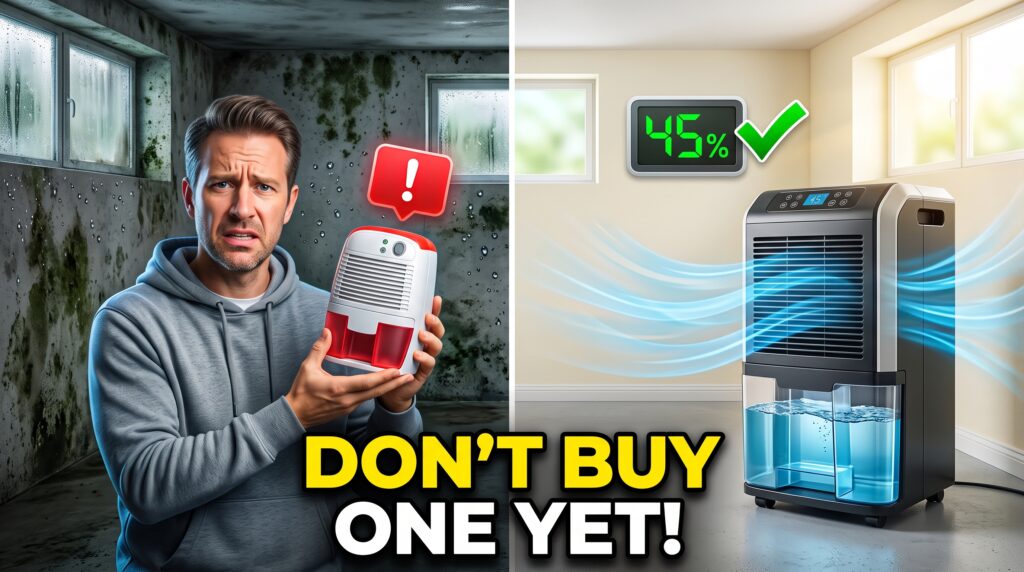
Before Purchasing a Dehumidifier, Read This
If your basement becomes odorous of mustiness, bathroom mirrors become foggy even after a shower, or you see mold growing around windows and walls, then you likely have too much humidity. In warm and humid climates these issues can create an uncomfortable home and even become indoor air quality issues in hot and humid months. This is when many homeowners start looking for a dehumidifier that will just solve the problem in a flash.
The answer is easy, at first: Use a dehumidifier, run it, and get rid of the moisture in just one or two days. But not everything is as simple as it sounds. Some may find that they have to empty out the water tank every few hours, and others may find the room is still humid even after it keeps running. In larger areas like basements, a smaller unit might not make a significant impact at all.
These frustrations can often make homeowners feel like dehumidifiers aren’t effective. The real issue isn’t typically the device, it’s about selecting the appropriate size or type for the space. A well-chosen dehumidifier can help you dehumidify and increase comfort, avoid mold issues and save homes. The important thing to remember is to know what kind of humidity issue you have and choose a unit that is going to address it.
Why This Problem Happens
The most crucial criterion in choosing a dehumidifier is the capacity you need for your home. Dehumidifiers can remove moisture from the air, which is measured in the number of pints of water per day. The dehumidifier’s capacity should equal the size of the room and the severity of the humidity problem. Often a unit is selected by intuition only, which can result in poor performance and frustration.
Also, remember that not all dehumidifiers function in the same manner. There are basically two kinds: The compressor dehumidifiers and the desiccant dehumidifiers. Generally the compressor models are the best models for warm humid environments like living rooms, bedrooms and finished basements. They use less energy and are effective at higher temperatures. Desiccant dehumidifiers, however, work better in cooler areas such as unheated basements, garages, storage rooms, and other areas where compressor dehumidifiers might not be as efficient.
There are two common mistakes homeowners may make which cause them to be dissatisfied with their dehumidifier. The first is the choice of a unit that is smaller than the area, which means it must operate all the time to keep humidity down, but it cannot. Secondly, they choose the dehumidifier that is not suitable for the temperature of the room. Correct sizing and technology will ensure proper moisture control and comfort over time to match your space.
Common Mistakes People Make
- Purchasing to be the lowest cost or largest without verifying the pint-per-day requirement for the room.
- Installing a standard compressor dehumidifier in a cold basement where performance is quite low when temperatures fall below 65°F.
- No baseline for the room humidity before purchase by not checking with a hygrometer.
- Mounting the unit against wall or corner, limiting ventilation and reducing moisture evaporation rate.
- Relying on the tank being emptied manually, constantly instead of on a continuous drainage option.
- Not taking into account noise levels for units in bedrooms or home offices.
- Don’t forget to continue maintenance, such as filter cleaning and descaling, to ensure long-term performance.
Solutions: What to Check Before You Buy
- Measure your room and your humidity level. First, measure the size of your room and your room humidity. Get a true number to work on rather than guesstimate with a cheap hygrometer.
- Match capacity (pints/day) to room size and humidity. Match room size and humidity with capacity (pints/day). More capacitive units are required for larger or more humid spaces – manufacturer’s sizing charts are a good starting point.
- Choose the right type for the temperature. Select the most appropriate temperature type. Compressor models for normal indoor temps. Desiccant models for cold basements, garages and unheated areas.
- Look for a continuous drainage option. Look for a continuous drainage option. With the drain hose attachment, you won’t have to empty the tank several times a day in humid environments.
- Check the noise level if it’s going in a living space or bedroom. If it is going into a living room or bedroom check the noise level. Check for a dB rating, which is found on the lower fan speed.
- Give it proper airflow clearance. Keep some detachment from walls and furniture so air can mingle freely.
- Look for a built-in humidistat or auto shut-off. This will prevent the unit from idling after the desired humidity is reached, thus conserving energy.
- Affiliate Product Recommendations
- Frigidaire FFAD7033R1 — A good mid-size model for medium to large rooms with a continuous drain connection.
- hOmeLabs Energy Star Dehumidifier — Higher-capacity choice built for larger basements or multi-room coverage.
- Vremi 50 Pint Dehumidifier — A good, general use dehumidifier for medium-sized basements or living spaces.
- Pro Breeze Electric Mini Dehumidifier — A small desiccant dehumidifier that works well in RVs, small bathrooms, closets, etc.
- Eva-Dry E-333 Mini Dehumidifier — Non-electric, low maintenance dehumidifier for small enclosed areas such as cabinets or gun safes,
Product Comparison
Model | Type | Best For | Continuous Drain | Notes |
Frigidaire FFAD7033R1 | Compressor | Medium–large rooms | Yes | Good balance of capacity and price |
hOmeLabs Energy Star | Compressor | Large basements | Yes | Higher capacity for bigger spaces |
Pro Breeze Mini | Desiccant | Small/cold spaces | No (manual tank) | Best for closets, cabinets, RVs |
Final Recommendation
Do some testing to see how much humidity and temperature are in the space for which you are planning to buy a dehumidifier, and take a few days to figure it out. Knowing the conditions of the room can help you determine the proper size and type of dehumidifier to invest in, otherwise you’ll be spending your money on the wrong unit for the room.
Generally, mid-capacity compressor dehumidifiers are the ideal choice for most residences. They are effective in warm and moderately humid rooms like bedrooms, living rooms and finished basements. A continuous drain option will also help you to avoid the extra work of water tank emptying.
A desiccant dehumidifier, however, may be a superior alternative in cooler climates, like an unheated basement, a garage, a storage room or any other enclosed space. These work more efficiently in low-temperature applications for which compressor models are not effective.
For beginners, what they need is a reliable mid-range compressor dehumidifier such as the Frigidaire FFAD7033R1 for use in the home. If the size of the space or the temperature is the issue, a smaller (and cooler) desiccant like the Pro Breeze Mini might be a solid option to start with. Starting with the right unit from the get-go will help you enjoy better moisture control, improved comfort, and long-term satisfaction.