
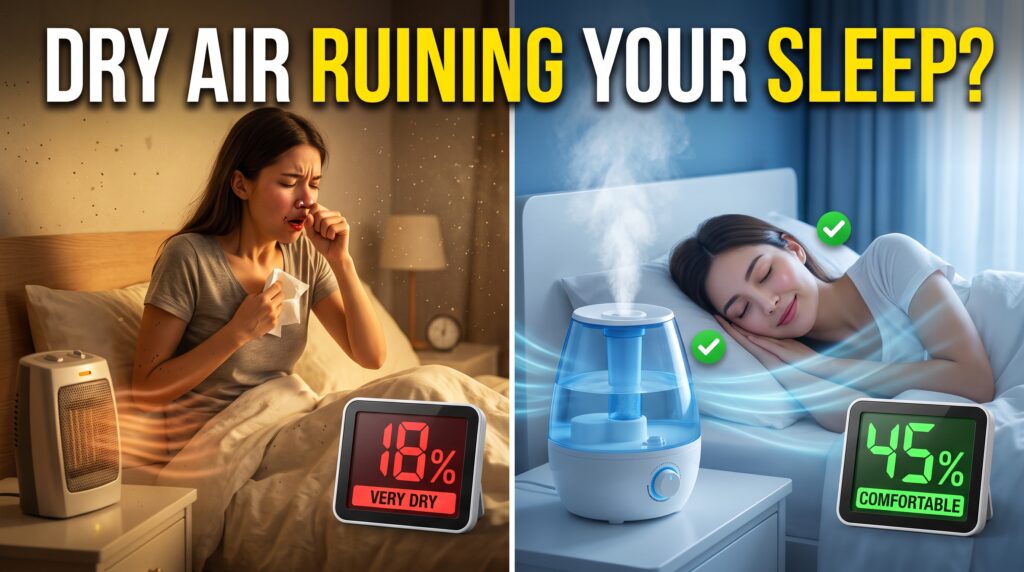
Is Dry Air Affecting Your Sleep?
You go to bed feeling fine and wake up at 3 a.m. with a throat so dry it actually hurts to swallow. Or maybe it’s your nose — stuffed up for no obvious reason, forcing you to breathe through your mouth, which leaves you parched by morning. Lips cracked, skin tight, maybe even a static shock off the blanket. None of this feels like a big deal on its own, but string enough of these nights together and you start to wonder why you’re waking up exhausted even though you technically slept eight hours.
There’s a decent chance the answer isn’t stress, screens, or your mattress. It might just be the air in your bedroom.
Why This Problem Happens
Humidity drops noticeably at night, especially during colder months when the heater is running for hours while you sleep. Heated air holds less moisture, and as it circulates through a closed bedroom all night, relative humidity can fall well below the comfortable range without you ever consciously noticing — you just wake up feeling off.
Your nose and throat are lined with mucous membranes that depend on a certain amount of moisture to function properly. When the surrounding air is too dry, those membranes dry out too, which can actually trigger more mucus production as a defensive response — meaning dry air can paradoxically leave you congested rather than just thirsty. That congestion pushes you toward mouth breathing, which dries out your throat even further and tends to make snoring worse, since dry tissue vibrates differently than well-hydrated tissue. It’s a small cascade, but it adds up to broken, lower-quality sleep over time, even if you never wake up enough to remember it the next morning.
Winter heating gets most of the blame, but it’s not the only culprit. Air conditioning pulls moisture out of the air too, which means hot, humid climates can produce the same dry-bedroom problem in the middle of summer if the AC runs all night. Either way, the mechanism is the same: a system designed to control temperature ends up controlling humidity as a side effect, usually in the wrong direction for comfortable breathing.
Common Mistakes People Make
Most people never actually check their bedroom’s humidity — they just notice they feel dry and assume it’s a minor, unavoidable part of winter. But a closed bedroom running a heater all night can sit well below 20% relative humidity, far under the 30–50% range that’s generally considered comfortable, and that gap is bigger than most people realize until they actually measure it.
Then there’s the overcorrection problem: someone finally buys a humidifier, cranks it up, and ends up with condensation on the windows or a faint musty smell within a week, because they pushed humidity too high without ever checking the actual number. Maintenance gets skipped too — a humidifier that isn’t cleaned regularly can grow mold or bacteria, which doesn’t exactly help you breathe easier at night. People also tend to buy a unit sized for the whole house when what they really needed was something appropriately sized and quiet enough for a single bedroom. And a lot of folks reach for nasal sprays or lozenges as a nightly band-aid without addressing the humidity issue actually causing the problem in the first place.
Solutions: How to Actually Fix It
The first step costs almost nothing: get a small hygrometer and put it on your nightstand for a few nights. Bedroom humidity at night can be very different from whatever your thermostat or whole-house reading shows, especially with the door closed and heat running, so this gives you a real number instead of a guess. If it’s consistently dropping below 30%, that’s a solid sign dry air is part of what’s disrupting your sleep.
From there, a humidifier sized for a bedroom — not a whole floor — is usually the right move. Cool-mist options tend to be the safer, lower-maintenance choice for a space where you’re sleeping nearby, since there’s no risk of burns from spilled hot water. Whatever type you choose, actually clean it regularly; a few minutes with a vinegar rinse every few days keeps mold and bacteria from building up, which matters even more in a room where you’re breathing that air for eight hours straight. If you’re using an ultrasonic model, stick to distilled water so you’re not adding mineral dust to the air you’re trying to improve.
A few smaller adjustments help too: lowering the thermostat slightly overnight means less drying heat moving through the room, cracking the bedroom door a little allows some natural air exchange, and keeping the humidifier a reasonable distance from your nightstand or electronics avoids any moisture issues nearby. If congestion is a recurring problem specifically, a saline nasal spray before bed can offer some short-term relief while the humidity in the room has time to come up to a healthier level overnight.
Affiliate Product Recommendations
- ThermoPro TP50 Digital Hygrometer — An inexpensive way to actually see your bedroom’s humidity instead of guessing at it.
- LEVOIT Classic 300S Smart Humidifier — Lets you schedule it to run automatically before bed and shut off in the morning, handy for hands-off overnight use.
- Honeywell HCM350 Cool Mist Humidifier — A quiet evaporative option well suited to bedroom use without much upkeep.
- Pure Enrichment MistAire Ultrasonic Humidifier — compressed and particularly quiet, a solid choice for a nightstand without troubling sleep.
- Vicks Filter-Free Cool Moisture Humidifier — A simple, budget-friendly pick sized appropriately for a single bedroom.
Product Comparison
Product | Noise Level | Smart Features | Best For |
LEVOIT Classic 300S | Very quiet | App control, scheduling | Hands-off nightly routine |
Honeywell HCM350 | Moderate (fan-based) | None | Low-maintenance bedroom use |
Pure Enrichment MistAire | Extremely quiet | None | Light sleepers, small rooms |
Final Recommendation
Before assuming your sleep troubles are something more complicated, spend a few nights tracking your bedroom’s actual humidity. It’s a small, cheap step that often explains a lot — dry throat, restless waking, even snoring that seems to come out of nowhere some nights and not others.
If the numbers come back low, a quiet, appropriately sized humidifier paired with a bit of regular cleaning is usually enough to notice a real difference within a week or two. It’s one of those fixes that’s easy to overlook simply because dry air doesn’t announce itself the way a noisy neighbor or an uncomfortable mattress would — it just quietly chips away at your sleep until you finally trace it back to the source.
And if you’re already dealing with a humidifier that doesn’t seem to be helping, it’s worth double-checking that it’s actually being used correctly — wrong room size, a dirty tank, or tap water in an ultrasonic model can all quietly undo the benefit you’re expecting to see.